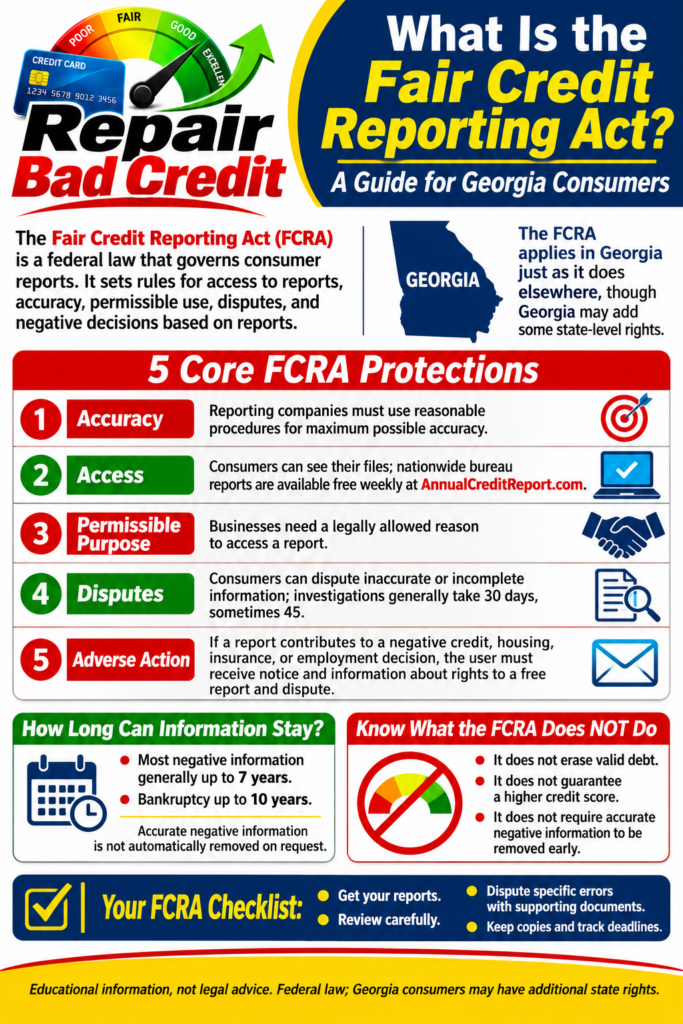
If you’ve searched “what is the federal Fair Credit Reporting Act,” here is the short answer. The Fair Credit Reporting Act (FCRA) is the federal law that governs consumer reports: the files kept by credit bureaus and other companies that sell information about how you handle credit, rent, and other financial obligations. It sets rules for who may see your report, how accurate the information must be, how long negative items can stay, and what happens when you say something is wrong.
The FCRA applies the same way in Atlanta as in any other state. Georgia adds a few state-level rights, which are noted below, but the core protections come from federal law. Congress passed the FCRA in 1970, and it has been amended many times since, most notably by the Fair and Accurate Credit Transactions Act of 2003 and a 2018 law that made credit freezes free.
This guide explains the law at an introductory level. Practical how-to steps live in separate guides, linked throughout.
The Names People Use for This Law
You may see the FCRA called the “federal credit reporting act,” the “consumer credit report act,” or the “fair credit reporting agency law.” Those are informal or imprecise names for the same statute, codified at 15 U.S.C. § 1681 and following. They are not separate laws.
The FCRA is also different from:
- The Fair Credit Billing Act, which deals with errors on credit card and other revolving-account statements. See Fair Credit Billing Act vs. Fair Credit Reporting Act.
- The Equal Credit Opportunity Act, which prohibits discrimination in lending. See our Equal Credit Opportunity Act guide.
Who the FCRA Covers
The law reaches three main groups.
Consumer reporting companies. The best known are the three nationwide credit bureaus: Equifax, Experian, and TransUnion. The FCRA also covers specialty companies, such as tenant-screening services, check-verification companies, and some employment-screening firms.
Furnishers. These are the businesses that send information to the bureaus: credit card issuers, auto lenders, student loan servicers, collection agencies, and others.
Users. These are the businesses that pull your report to make decisions about credit, insurance, housing, employment, or another permitted purpose.
Each group has different duties. A bureau must use reasonable procedures to keep reports accurate. A furnisher must not report information it knows is inaccurate, and it must investigate certain disputes. A user must have a legally permitted reason to get your report and must tell you when information in the report led to a negative decision.
The Five Core Ideas, in Plain English
1. Accuracy
Consumer reporting companies must follow reasonable procedures to ensure the maximum possible accuracy of what they report, as the Consumer Financial Protection Bureau explains. That does not mean every report is error-free. It means the law gives you tools to challenge information that is wrong or incomplete.
2. Access
You have the right to see what is in your file. For the three nationwide bureaus, that is now easy. The bureaus have permanently extended a program that lets anyone check their reports for free once a week at AnnualCreditReport.com, the only website authorized for the free federal reports, according to the Federal Trade Commission. Georgia residents have an additional state right to free reports, explained in How Georgia Consumers Can Get Free Credit Reports.
3. Permissible Purpose
A business cannot pull your report just because it is curious. The FCRA lists the purposes that qualify, such as evaluating an application for credit, insurance, or a rental, or employment screening with your written permission. If a company pulls your report without a permissible purpose, that may be a violation worth discussing with a lawyer.
4. Disputes
If your report contains information you believe is inaccurate or incomplete, you can dispute it with the bureau, the business that supplied it, or both. The CFPB says a bureau generally must investigate within 30 days and tell you the results within five business days after it finishes. In some situations the deadline stretches to 45 days, as the CFPB explains. The step-by-step process is covered in How to Dispute a Credit-Report Error Yourself in Georgia.
5. Adverse Action
When a lender, landlord, insurer, or employer takes a negative action based in whole or in part on a consumer report, it must tell you. That notice must name the reporting company it used and explain your right to a free copy of the report and to dispute errors. The FTC notes that you generally must request that free report within 60 days of the notice. Reading those notices is covered in Denied Credit in Atlanta? How to Read an Adverse-Action Notice.
Specialty Reports Matter Too
Most people think only of Equifax, Experian, and TransUnion, but the FCRA also covers nationwide specialty consumer reporting companies. These include companies that track rental history, check-writing and bank-account history, insurance claims, and employment background. A landlord in Atlanta might rely on a tenant-screening report. A bank deciding whether to open a checking account might check a deposit-account history report.
The same core rights apply to these files: access, accuracy, and disputes. If you are denied an apartment or a bank account, the notice should name the company that supplied the report. Request that specific file rather than assuming a credit bureau report was the problem.
How Long Information Can Stay on Your Report
The FCRA limits how long most negative information can be reported. The CFPB says a credit reporting company generally can report most negative information for seven years, and bankruptcies can stay for up to ten years. Lawsuits and judgments can be reported for seven years or until the statute of limitations runs out, whichever is longer, according to the CFPB.
There are exceptions. Those time limits do not apply when the report is used for a job paying more than $75,000 a year, or for more than $150,000 of credit or life insurance.
Positive information, such as years of on-time payments, may stay longer. Accurate negative information does not have to be removed early just because you ask.
A Hypothetical Atlanta Example: Checking Before a Rental Application
This example is hypothetical and simplified.
Dana lives in DeKalb County and plans to apply for an apartment in Midtown in six weeks. She knows many landlords use tenant-screening reports and may also look at a credit report, so she takes these steps:
- She downloads her three nationwide credit reports from AnnualCreditReport.com and saves them as PDFs.
- She notices a credit card she closed years ago listed as “open.” She also sees a collection account with a balance she believes she paid in 2023.
- She gathers her paid-in-full letter and bank statements showing the payment.
- She files a dispute about the collection balance with each bureau showing it, attaching copies (not originals) of her proof. She also writes to the collection agency that reported it.
- She calendars the 30-day investigation window and plans to check the results before she applies.
What Dana does not do: she does not dispute accurate late payments from a period when she was behind, and she does not claim identity theft for accounts she opened. Disputing accurate information is not a legitimate shortcut. Filing a false identity-theft claim can create serious legal problems.
Dana also learns that a landlord may use a specialty tenant-screening company rather than one of the big three. If she is denied, the adverse-action notice should name the company used, and she can request that file.
What the FCRA Does Not Do
Some online claims stretch the FCRA well beyond what it says. Watch for these misconceptions:
- “The FCRA wipes out debt.” It does not. The FCRA governs reporting, not whether you owe money. Correcting an inaccurate report does not automatically cancel an underlying debt. We explain this in detail in Does the Fair Credit Reporting Act Eliminate Debt?.
- “If a bureau can’t ‘verify’ something, every negative item must disappear.” The law requires investigation of disputed information. Information that is verified as accurate can stay.
- “The FCRA guarantees a higher score.” No law guarantees a score increase. Scores are calculated by scoring models, not set by the FCRA.
- “Medical debt can never appear on a report.” A CFPB rule that would have removed most medical bills from credit reports was vacated by a federal court on July 11, 2025, according to the CFPB’s archived announcement. Properly coded medical debt may still be reported, although bureau policies and some state laws may limit it.
Rights, Practical Steps, and When to Get Legal Advice
| Category | Examples |
| Your legal rights under the FCRA | Access to your file; disputing inaccurate or incomplete information; adverse-action notices; limits on who can see your report; reporting time limits |
| Practical suggestions (not legal requirements) | Check all three reports before major applications; keep copies of everything; dispute in writing with specific documents; track deadlines on a calendar |
| Situations that may need individualized legal advice | A bureau repeatedly reinserts information you proved wrong; you were denied housing or a job because of someone else’s records mixed into your file; a company pulled your report without permission; you are being sued over a debt |
If you live in Clayton, Cobb, DeKalb, Fulton, or Gwinnett County and meet income guidelines, the Atlanta Legal Aid Society may be able to help (404-524-5811). Georgians outside those five counties can contact the Georgia Legal Services Program (1-833-457-7529). Both have eligibility rules, so ask before assuming you qualify.
Where to Complain
If you believe a bureau or furnisher violated the FCRA, you can:
- Submit a complaint to the CFPB at consumerfinance.gov/complaint. Its online complaint portal remained open as of late 2026, although the agency has narrowed its enforcement activity.
- Report the problem to the FTC at ReportFraud.ftc.gov.
- Contact the Georgia Attorney General’s Consumer Protection Division at 404-651-8600 or 1-800-869-1123 (toll-free in Georgia).
A complaint is not a lawsuit, and it does not guarantee a particular result. It does create a record, and a company often must respond.
Next Step
Start with the information itself. Pull your free reports, read them section by section with our guide to reading your credit report, and write down anything you believe is inaccurate. Then review Your FCRA Rights: Understanding Credit-Report Notices so you know what each letter you receive means.
Contact Us
We would love to hear from you! Please fill out this form and we will get in touch with you shortly.