Urgent Credit Report Questions in Georgia and Beyond
When your credit feels like an emergency and you don’t know where to start, you need clear information fast. Turn to Repair Bad Credit for straight explanations, step-by-step options, and links to trustworthy resources you can use right away.
Contact Us
We would love to hear from you! Please fill out this form and we will get in touch with you shortly.
Credit Reports: How to Get, Read, and Check Yours
A credit report is a record of how you’ve handled credit, such as loans, credit cards, and some other bills. It’s kept by companies called consumer reporting companies. Lenders, landlords, insurers, and some employers may use it when they make decisions about you. You have the right to see what’s in your reports, for free, and to dispute information you believe is wrong.
This page helps you:
- Find the official place to get your free reports
- Understand the main sections of a report
- Spot questions worth looking into
- Choose a sensible next step
We publish educational guides that help readers understand credit reports and investigate their options. We don’t provide credit reports ourselves, we don’t ask for your Social Security number, and we don’t dispute accounts on anyone’s behalf.
Find Out How to Get Your Reports · Learn How to Read Your Report
What Is a Credit Report?
A consumer credit report is a summary of your credit history. The Federal Trade Commission explains that federal law, the Fair Credit Reporting Act, requires the nationwide credit bureaus to make sure the information they collect about you is accurate, give you a free copy of your report once every 12 months, and let you dispute mistakes (FTC).
Who keeps reports. The three nationwide credit bureaus are Equifax, Experian, and TransUnion. Specialty companies also keep reports on things like rental history, check writing, and insurance claims.
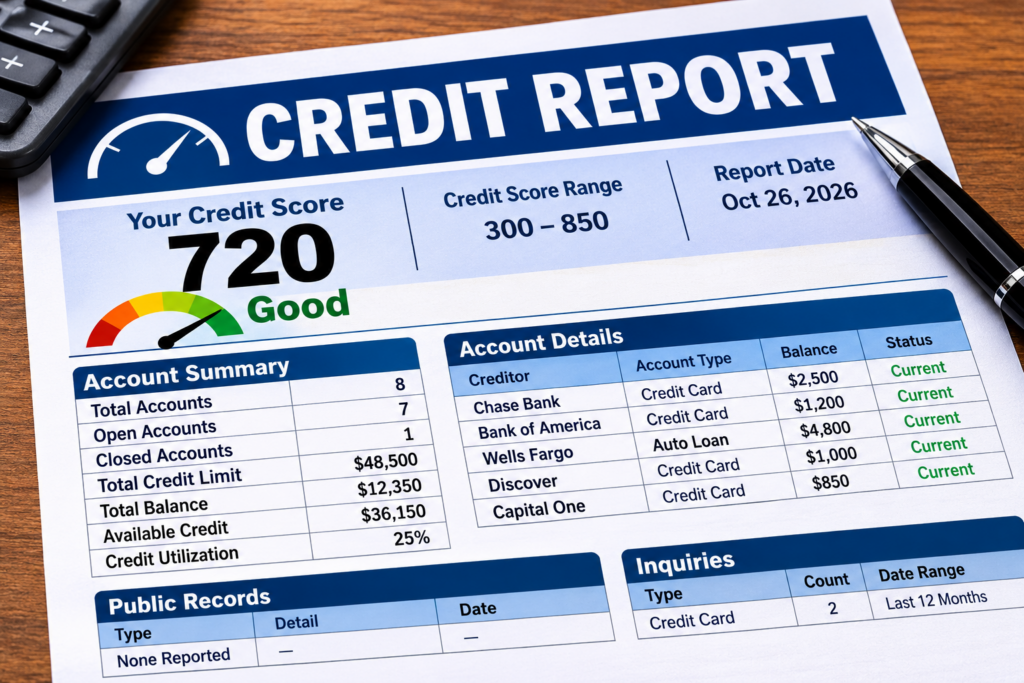
What’s usually in them. Identifying details, credit accounts and their payment history, collection accounts, inquiries from companies that pulled your report, and certain public-record information, such as bankruptcies.
Who can see them. Federal law limits who can get your report and why, such as a lender reviewing your application or an employer with your written permission. You can always see your own.
Why your reports may differ. Not every lender reports to every bureau, and updates arrive at different times.
What a report doesn’t show. It isn’t a full financial picture. It generally leaves out income and bank balances, and rent or utilities may not be reported.
For the legal background, see our guide to the Fair Credit Reporting Act.
Choose What You Need Help With
| Your question | Where to start | What the guide helps you do |
| “I need a copy of my report.” | Free credit reports guide | Use the official free sources and avoid look-alike sites |
| “I have a report but don’t understand it.” | How to read your credit report | Go section by section and turn confusion into specific questions |
| “An account or detail looks wrong.” | How to dispute a credit-report error | Gather evidence, send the dispute to the right place, and track responses |
| “I don’t recognize an account.” | Identity theft and your credit | Check whether it’s legitimate before acting, then use identity-theft tools if needed |
| “I was denied credit.” | How to read an adverse-action notice | Find the stated reasons and the report that was used |
| “I want to understand my rights.” | Fair Credit Reporting Act overview | Learn what the law requires of bureaus, lenders, and other users |
Where to Get Your Credit Reports
The official source is AnnualCreditReport.com. The FTC says it’s the only website authorized to fill orders for the free annual credit reports you’re entitled to by law (FTC).
→ Go to AnnualCreditReport.com, the official free-report site
There are two kinds of free access, and it helps to know the difference:
- Your legal right. Federal law requires each nationwide bureau to give you a free copy of your report once every 12 months if you ask.
- A voluntary program. The three bureaus have permanently extended a program that lets you check your report from each of them once a week for free at AnnualCreditReport.com (FTC). The FTC also says Equifax is offering six additional free reports per year through 2026 (FTC).
You can also request reports by phone at 1-877-322-8228, or by mail to Annual Credit Report Request Service, P.O. Box 105281, Atlanta, GA 30348-5281 (CFPB).
Getting a report isn’t the same as buying monitoring. Monitoring products alert you to changes and are optional. You don’t need a subscription, free trial, or any product we mention to get free reports. Some “free” trials become paid subscriptions.
Check where you are before typing anything. Imposter sites mimic the official name. Type the address yourself, and confirm you’re on AnnualCreditReport.com before entering your Social Security number.
Full ordering steps are in our free credit reports guide.
Credit Report vs. Credit Score
| Feature | Credit report | Credit score |
| What it is | A detailed record of your accounts, payment history, inquiries, and certain public information | A number calculated from report data to estimate credit risk |
| Who creates it | Consumer reporting companies | Scoring models, applied by bureaus, lenders, or others |
| Included in free reports from AnnualCreditReport.com? | Yes | No |
| Can you have more than one? | Yes, one from each bureau, and they may differ | Yes, many different scores exist |
| Can you dispute it? | You can dispute inaccurate information in it | You can’t dispute a score directly, only the report data behind it |
Free reports from AnnualCreditReport.com don’t include credit scores (Experian). You may see different scores because lenders and apps use different scoring models and different bureaus’ data.
Neither guarantees a lending decision, since lenders also weigh income and their own criteria. Checking your own report doesn’t hurt your credit or improve it. It simply shows you what lenders see.
What to Review on Your Credit Report
The examples below are fictional illustrations, not real report data.
Personal identifying information
Purpose: helps match the report to you. Example to review: an address in a city where you’ve never lived. When to look further: unfamiliar names or addresses can signal a mixed file or identity theft, though misspellings are common and harmless.
Credit accounts
Purpose: lists your loans and credit cards. Example to review: a card listed under a bank name you don’t recognize. When to look further: store cards are often reported under a bank’s name, and loans move to new servicers. Check before assuming fraud.
Payment and account details
Purpose: shows balances, limits, status, and month-by-month payment history. Example to review: a loan you paid off still showing a balance. When to look further: compare with your statements. A recent payment may not show yet, but a months-old balance may be an error.
Collections
Purpose: shows debts placed with or sold to collection agencies. Example to review: a medical collection for a bill your insurance paid. When to look further: check the original creditor and amount, and look for the same debt listed twice.
Inquiries
Purpose: shows who accessed your report. Example to review: a hard inquiry from a lender you never applied to. When to look further: dealers sometimes send one application to several lenders. An inquiry you can’t explain at all deserves a closer look.
Public records
Purpose: certain court-related information, such as bankruptcy. Example to review: a bankruptcy entry with a wrong filing date. When to look further: the CFPB says bankruptcies can be reported for up to ten years and most other negative information for seven (CFPB). An entry older than those limits may be worth questioning.
Our report-reading guide covers each section in depth.
What If You Find Something That Looks Wrong?
Start by figuring out which situation you’re in:
- A factual error. For example, a wrong balance, a late payment you can show was on time, or a closed account reported as open.
- An unfamiliar but possibly legitimate entry. For example, a store card reported under the bank’s name, or a loan sold to a new servicer. Verify it first.
- Accurate information you wish weren’t there. Accurate negative information can generally stay for the legal reporting period. Disputing it simply because it hurts isn’t a legitimate strategy.
- Possible identity theft. Accounts you didn’t open and didn’t authorize.
For a genuine error, the general approach is:
- Identify the specific item and exactly what’s wrong.
- Gather records that show it, such as statements, payment confirmations, or letters.
- Check the bureau’s current dispute instructions. The FTC explains how to dispute with the bureau and with the business that reported the information (FTC).
- Send copies, not originals, and keep a record of everything you send and receive.
- Watch for the results. The CFPB says bureaus generally must investigate within 30 days (CFPB).
A dispute doesn’t guarantee deletion or cancel a debt you owe. Never make false statements. For identity theft, the federal starting point is IdentityTheft.gov.
Our dispute guide and identity-theft guide cover these steps in full.
What If You Were Denied Credit?
If a lender turns you down, the letter it sends, called an adverse-action notice, can point you to the problem. Read its actual wording carefully. It should tell you the reasons for the decision, or how to request them, and it should name the reporting company whose report was used. If the decision was based on a report, you can get a free copy from that company if you ask within 60 days (FTC).
A denial doesn’t by itself mean there’s a reporting error or unfair treatment. Compare the stated reasons with your report. Our adverse-action guide explains how to read the notice. Our guide to the Equal Credit Opportunity Act explains lenders’ duty to give reasons.
Credit Freezes, Fraud Alerts, and Monitoring
| Tool | Main purpose | Important limitation |
| Credit freeze | Restricts access to your report so new credit is hard to open in your name. Free, and must be placed at each bureau | Doesn’t stop misuse of accounts you already have. Lift it temporarily when you apply for credit |
| Fraud alert | Tells businesses to verify your identity before opening new credit. Free, lasts one year, and one bureau notifies the other two | Doesn’t block access. It relies on businesses checking |
| Credit monitoring | Alerts you when something on your report changes | Can’t prevent fraud or remove inaccurate information. Free options exist, and a paid subscription isn’t necessary for everyone |
Freezes must be placed within one business day of an online or phone request and lifted within one hour (USA.gov). An initial fraud alert lasts one year, and you only need to contact one bureau (FTC). No tool prevents every form of identity theft.
Our freeze vs. fraud alert guide helps you choose.
Credit-Report Resources for Atlanta and Georgia Readers
Federal law is the foundation of this page and works the same way in Atlanta as anywhere else. Georgia adds a few things:
- Extra free reports. The Georgia Attorney General says Georgia residents are entitled by the state’s Fair Business Practices Act to two additional free credit reports from each bureau per year (Georgia AG). These are separate from the federal options.
- Credit repair rules. The Georgia Attorney General says that, with very few exceptions, credit repair is prohibited by Georgia law, and that accurate negative information can’t legally be removed (Georgia AG). You can dispute errors yourself for free.
- Complaints. The Georgia Attorney General’s Consumer Protection Division takes consumer complaints online, at 404-651-8600, or at 1-800-869-1123 (toll-free in Georgia).
- Legal help. The Atlanta Legal Aid Society serves low-income residents of Clayton, Cobb, DeKalb, Fulton, and Gwinnett counties (404-524-5811). Georgians over 60 can call Georgia Senior Legal Aid (404-389-9992) (Georgia Courts). The Georgia Legal Services Program serves low-income Georgians in the 154 counties outside metro Atlanta (GLSP). Income and other eligibility rules apply.
There’s no Atlanta-specific dispute process or deadline.
A Simple Credit-Report Review Checklist
- ☐ Get your reports from AnnualCreditReport.com, the official source
- ☐ Save each report securely, with a password, on a device you control
- ☐ Confirm the name, addresses, and other details are yours
- ☐ Review each account’s balance, status, and payment history
- ☐ Check collections and inquiries
- ☐ Write down specific questions about anything you don’t recognize or think is wrong
- ☐ Gather records before disputing anything
- ☐ Keep copies of everything you send and receive
- ☐ Use IdentityTheft.gov if accounts aren’t yours
- ☐ Protect your information; never email your full report to anyone who doesn’t need it, including us
Frequently Asked Questions About Credit Reports
Is a credit report the same as a credit score? No. A score is a number calculated from report data, and free reports don’t include one.
Can I get a report without paying for monitoring? Yes. AnnualCreditReport.com doesn’t require buying anything.
Why do my reports differ? Lenders don’t all report to every bureau, and updates arrive at different times.
Does every unfamiliar account mean identity theft? No. Accounts can appear under a bank’s or servicer’s name. Verify the account before reporting identity theft.
Can accurate negative information be disputed simply because it hurts? Disputes are for information you believe is inaccurate or incomplete. Accurate information can generally stay for the legal reporting period.
Where should I start if I live in Georgia? AnnualCreditReport.com, like everyone else. Then see the Georgia resources above.
Start With the Question That Fits Your Situation
Pick your next step: getting a report, understanding an entry, investigating an error, or learning your rights.
Get Your Credit Reports · Read Your Report · Understand Report Disputes