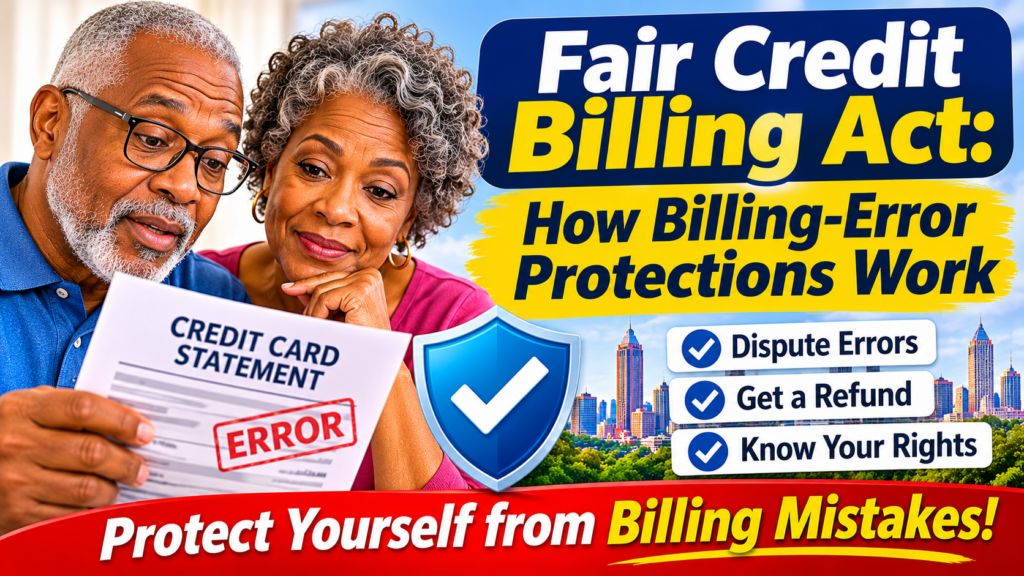
Here is the Fair Credit Billing Act definition in plain terms. The Fair Credit Billing Act (FCBA) is a federal law that gives you a formal way to challenge certain errors on the statements for open-end credit accounts, mainly credit cards and revolving charge accounts. If you send a proper written notice in time, the creditor must investigate, and it must follow rules about collecting and reporting the disputed amount while it does.
The FCBA is part of the federal Truth in Lending Act framework and is carried out through Regulation Z. It is not a general right to cancel any purchase you regret. It is not a credit-report dispute law either. Knowing which problems it covers, and the deadlines that protect your rights, is what makes it useful.
You may hear it called the “Fair Billing Act” or the “FCBA.” Those are informal names for the same law.
Which Accounts the FCBA Covers
The FTC explains that the law applies to open-end credit accounts, such as credit cards and revolving charge accounts (FTC Fair Credit Billing facts). In practice, that means:
- Covered: general-purpose credit cards, store cards, and other revolving lines where you can borrow repeatedly up to a limit.
- Generally not covered: installment loans with fixed payments, such as most auto loans, personal loans, and mortgages. Those may have other protections, but the FCBA’s billing-error procedure is built for open-end accounts.
- Debit cards: debit card and bank-account errors fall under a different federal law, the Electronic Fund Transfer Act, which has different deadlines and liability limits. Don’t use the FCBA procedure for a debit card problem.
What Counts as a “Billing Error”
The FCBA lists specific types of billing errors. Based on FTC and Regulation Z guidance, they include:
- A charge you did not make or authorize, or a charge from someone not authorized to use your account
- A charge with the wrong date or the wrong amount
- A charge for goods or services you did not accept, or that were not delivered as agreed
- A math error on the statement
- A payment or credit (such as a refund) that was not properly posted
- A statement mailed to the wrong address, if you gave the creditor your change of address in writing at least 20 days before the billing period ended
- A charge for which you are asking for an explanation or documentation
The full definitions are in Regulation Z, 12 CFR 1026.13. The details matter, so read the regulation or ask your card issuer for its billing-rights summary.
What Is Not a Billing Error
Simply being unhappy with the quality of something you bought is generally not a “billing error” in the FCBA sense, unless the item was not delivered or accepted as agreed. Federal rules have a separate provision about asserting claims and defenses against a card issuer over a quality dispute. It has its own conditions and differs from the billing-error procedure. Many card networks also run voluntary chargeback programs with their own timelines. Those are contract terms, not the FCBA.
The Deadlines That Protect Your Rights
The FTC explains the core timeline (FTC):
- You: Send a written notice so it reaches the creditor within 60 days after the first statement containing the error was sent to you.
- Creditor: Must acknowledge your notice in writing within 30 days of receiving it, unless it has resolved the problem by then.
- Creditor: Must resolve the dispute within two billing cycles, but no more than 90 days, after receiving your notice. It does this by correcting the error or explaining why it believes the bill is correct.
Two points are easy to miss:
- The 60 days runs from when the first statement showing the error was sent, not from when you noticed it. If you don’t open statements for months, you may lose these protections.
- Your notice must go to the address for billing inquiries. That is often different from the address where you send payments. It is usually printed on the statement.
A phone call to customer service can solve many problems quickly. To preserve your FCBA rights, though, send the written notice too. Our guide to writing a credit-card billing-error letter walks through the contents and gives a sample.
What Your Notice Should Include
The FTC advises including:
- Your name and account number
- The amount of the suspected error and a description of it
- Why you believe it is an error
- Copies (not originals) of receipts or other supporting documents
Many people send the letter by certified mail with a return receipt so they can show when it arrived. Some issuers also accept disputes through an online portal. If you use one, check the issuer’s terms to confirm whether that counts as written notice under the FCBA, and keep screenshots.
Your Payment Responsibilities During the Dispute
This is where people get into trouble, so read carefully.
- You may withhold the disputed amount and related charges while the creditor investigates.
- You should still pay the undisputed part of your bill, including at least any minimum payment owed on undisputed amounts.
- The creditor may not threaten your credit or report the disputed amount as delinquent while the dispute is pending. It may report that the amount is in dispute.
- The creditor may not take collection action on the disputed amount during the investigation.
The FCBA does not tell you to stop paying your card. It lets you hold back only the specific amount you have properly disputed. Not paying your other balances can still lead to late fees, penalty interest, and negative reporting.
If the Creditor Decides the Charge Was Correct
If the investigation concludes there was no error, the creditor must explain why and tell you what you owe, which may include finance charges that accrued on the disputed amount. Guidance commonly describes a short period before the creditor can report the amount as late. Experian, for example, describes a waiting period of at least 10 days. Read the creditor’s explanation letter for the exact payment date it gives you.
If you still disagree, you can tell the creditor in writing. Rules then limit how the creditor reports the account to others. This step is technical, so consider getting advice if a large amount is at stake.
Unauthorized Charges and the $50 Limit
Federal law also limits your liability for unauthorized use of a credit card to $50, and many issuers voluntarily offer $0 liability. If someone stole your card or card number, report it to the issuer right away. Then use the billing-error process for the charges on your statement. If the theft is part of broader identity theft, see Identity Theft and Your Credit.
Billing Disputes vs. Credit-Report Disputes
A billing-error dispute goes to the creditor and is about the statement. A credit-report dispute goes to a credit bureau (or the furnisher) and is about the report. One wrong charge can lead to both kinds of problems. For example, if the creditor wrongly reports you late on a charge you disputed, you may need to address both. We map out that scenario in Fair Credit Billing Act vs. Fair Credit Reporting Act. If you see the phrase “account in dispute” on your report, see our explainer on what that label means.
A Hypothetical Atlanta Example
Hypothetical and simplified.
Andre, who lives in Decatur, books a $640 hotel stay in Savannah and cancels within the free-cancellation window. Two weeks later, the charge still appears on his credit card statement. The hotel’s front desk keeps promising a refund that never arrives.
Andre:
- Finds the statement date when the charge first appeared and counts 60 days forward.
- Writes to the card issuer’s billing-inquiries address. He identifies the $640 charge as a credit not properly posted, and includes his cancellation confirmation email.
- Mails it certified with a return receipt about three weeks after the statement date.
- Pays the rest of his balance on time, but not the $640.
- Receives an acknowledgment within a few weeks, and a correction on his next statement.
Andre doesn’t wait for the hotel’s promises past the deadline, and he doesn’t stop paying the rest of his bill.
Rights, Practical Steps, and When to Get Advice
| Category | Includes |
| Your FCBA rights | Written investigation of qualifying billing errors; acknowledgment and resolution deadlines; withholding the disputed amount; no negative reporting or collection of the disputed amount during the investigation |
| Practical steps | Read every statement promptly; dispute in writing to the correct address; use certified mail or keep portal records; pay undisputed amounts |
| Get advice if | The creditor ignored your timely notice; reported you late on a disputed amount; or the amount is large and the creditor disagrees after investigation |
The FTC enforces the FCBA for many creditors, and the CFPB oversees many large card issuers. Complaints can go to the CFPB (portal open as of late 2026), ReportFraud.ftc.gov, or the Georgia Attorney General’s Consumer Protection Division. Income-eligible residents can contact the Atlanta Legal Aid Society (Clayton, Cobb, DeKalb, Fulton, Gwinnett; 404-524-5811) or the Georgia Legal Services Program (1-833-457-7529).
Frequently Asked Questions
Does the FCBA apply to a charge I authorized but now regret? Generally no. Regret isn’t a billing error. If the item wasn’t delivered or accepted as agreed, that may qualify. Otherwise, look at the merchant’s return policy and your card’s voluntary dispute options.
Can I dispute by phone only? You can call, and many issues get fixed that way. The FCBA’s protections depend on written notice that reaches the billing-inquiries address in time, so follow up in writing.
What if the 60 days have passed? You may lose the FCBA’s formal protections, but you can still ask the issuer for help. Card network rules or the issuer’s own policies may allow a dispute. Unauthorized-use protections may also apply separately.
Will a billing dispute hurt my credit? While a proper FCBA dispute is pending, the creditor can’t report the disputed amount as delinquent. It may report that the amount is disputed. Paying the undisputed balance on time protects the rest of your account.
Next Step
Open your latest credit card statement now and find two things: the statement date and the “billing inquiries” address. Write both on a sticky note inside your bill folder. If an error ever appears, you’ll know your deadline and where to send the letter.
Contact Us
We would love to hear from you! Please fill out this form and we will get in touch with you shortly.