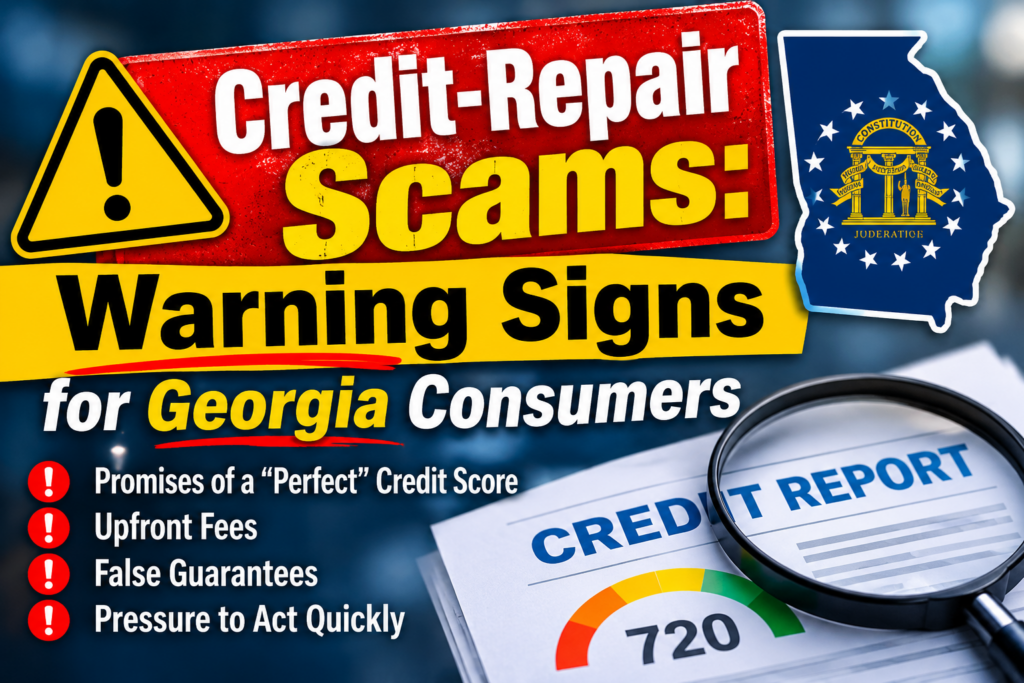
Credit repair scams follow a predictable script. A company promises to erase negative items, raise your score fast, or give you a “new credit identity,” then asks for money before doing anything. The FTC says plainly that no one can legally remove accurate negative information from your credit report (FTC). In Georgia there is an extra layer: state law generally prohibits for-profit credit repair, with very few exceptions, according to the Georgia Attorney General’s Consumer Protection Division.
This guide is about recognizing scams before you pay. The legal framework is covered separately in Is Credit Repair Legal? Federal Rules and Georgia Restrictions. If you have already paid, see Think You Paid a Credit-Repair Scam? What to Do Next.
Why Credit-Repair Scams Work
People usually look for credit help under pressure: an apartment application, a car that just died, a mortgage pre-approval that fell through. Scammers know that. Their pitches promise speed and certainty, which is exactly what the legitimate process can’t promise. Correcting genuine errors takes paperwork and waiting. Accurate negative information fades with time and better habits. Anyone selling a shortcut is selling something the law doesn’t support.
Ten Warning Signs
1. “We guarantee deletions” or “We’ll remove everything”
Accurate information can stay on your report for as long as the law allows. For most negative items, the CFPB says that is generally seven years, and up to ten years for bankruptcy (CFPB). A company that guarantees removal of accurate items is promising something it cannot lawfully deliver.
2. They want money first
Under the federal Credit Repair Organizations Act, credit repair companies cannot require payment until they have completed the promised services. The CFPB lists an upfront payment demand as a red flag (CFPB advisory). The Georgia Attorney General adds that it is illegal for companies to charge you up-front fees for credit repair. “Setup fees,” “first-work fees,” and “audit fees” collected before results are the same thing under another name.
3. They sell a “new credit identity,” CPN, or EIN workaround
Some companies sell a nine-digit “credit privacy number,” “credit profile number,” or “CPN,” or tell you to get an Employer Identification Number and use it instead of your Social Security number on credit applications. The FTC calls this a scam. The FTC and state attorneys general have warned that using a false identification number to apply for credit is a felony (FTC). CPNs are often stolen Social Security numbers, sometimes belonging to children. Using one could expose you to criminal charges, and it doesn’t fix your real credit history.
4. They tell you to dispute everything, including accurate items
Mass-disputing every negative item, true or not, is a hallmark of illegitimate operations. Disputes should be about information you honestly believe is inaccurate or incomplete. Filing false disputes wastes your credibility and may cause the bureau to treat later, legitimate disputes as frivolous.
5. They suggest filing an identity-theft report for debts you owe
Identity-theft reports carry legal weight. Filing a false one to get accurate accounts blocked is fraud. A real identity-theft victim has strong rights, explained in Identity Theft and Your Credit. Those rights are for real victims only.
6. They tell you not to contact the credit bureaus yourself
The CFPB lists this as a red flag. You have every right to contact Equifax, Experian, and TransUnion directly, for free.
7. They claim government affiliation or “new laws”
Watch for names, seals, or scripts implying a government program: “federal credit reset,” “new FCRA loophole,” “government-approved.” The free federal report site is AnnualCreditReport.com. The government doesn’t sell credit repair.
8. They pressure you to sign immediately or skip the contract
Federal law requires a written contract and gives you three business days to cancel. A company that won’t put terms in writing, rushes your signature, or skips over cancellation rights is ignoring basic requirements. The disclosures you should see are listed in What Must a Credit-Repair Company Disclose Before You Sign?.
9. They want unusual payment methods
Requests for payment by gift card, wire transfer, cryptocurrency, or a payment app to a personal account make your money very hard to recover. Legitimate businesses don’t demand them.
10. They promise an instant score jump or “tradelines”
Some sellers offer to add you as an authorized user on a stranger’s old account for a fee, promising a quick score increase. Results vary, lenders may discount these accounts, and some arrangements involve misrepresentation. Treat any guaranteed score number as a warning sign.
The Georgia Angle
Georgia law, O.C.G.A. § 16-9-59, makes it a misdemeanor to own, operate, or be affiliated with a “credit repair services organization.” That term means someone who, for money, offers to improve your credit record or rating, obtain credit for you, or advise you on either. The statute excludes certain groups, such as Georgia-licensed attorneys acting within their law practice and certain 501(c)(3) nonprofits. Article 6 explains the exclusions and their limits.
What this means for you as a consumer: if a for-profit company in Georgia is selling credit repair, ask which exclusion it claims to fall under before you share anything. “We’re compliant with federal law” doesn’t answer the Georgia question.
How to Protect Yourself Before You Pay
Before you give any company money, documents, or your Social Security number:
- Search the company name with “Georgia Attorney General,” “complaint,” and “lawsuit.”
- Ask, in writing, what exactly they’ll do that you can’t do yourself for free.
- Ask for the contract and federal disclosure statement before paying anything.
- Ask which Georgia exclusion they rely on, if they are for-profit.
- Never let a company create accounts in your name at the credit bureaus or keep your logins.
Keep a Record from Day One
If you’re talking with a company, save:
- Screenshots of ads, websites, and social media posts, with dates visible
- Every email, text, and voicemail
- Any contract, even unsigned drafts
- Payment receipts and bank or card statements
You may never need them. If something goes wrong, they’re the evidence that helps you report the company and pursue any refund options.
Free Alternatives That Actually Work
- Your own disputes. You can dispute errors directly with the bureaus and furnishers for free. See How to Dispute a Credit-Report Error Yourself.
- Free reports. Weekly free reports are available at AnnualCreditReport.com.
- Nonprofit credit counseling. The Georgia Attorney General recommends the National Foundation for Credit Counseling (800-388-2227, nfcc.org) for reputable counseling. Counseling is different from credit repair.
- Legal aid. If your situation involves lawsuits, identity theft, or serious errors, contact the Atlanta Legal Aid Society (Clayton, Cobb, DeKalb, Fulton, Gwinnett; 404-524-5811) or the Georgia Legal Services Program (other counties; 1-833-457-7529). Eligibility rules apply.
Rights, Suggestions, and Legal Questions
- Your rights: no up-front fees for federally covered credit repair; a written contract; a three-business-day cancellation right; the right to sue a company that violates the federal law.
- Practical suggestions: do the free steps first; never pay by gift card or wire; keep records.
- Questions for a lawyer: whether a specific Georgia business falls under a statutory exclusion; whether you can recover money already paid.
Frequently Asked Questions
Are all credit repair companies scams? No. But in Georgia, for-profit credit repair is generally prohibited unless a statutory exclusion applies. Nationally, the FTC warns that many credit repair offers are scams. Being careful is reasonable, and assuming every company is a fraud isn’t necessary. Ask the questions above and verify the answers.
What if a company says it’s a law firm? Georgia’s statute excludes Georgia-licensed attorneys acting within their law practice. Ask who your attorney is, check their license with the State Bar of Georgia, and confirm whether you will actually receive legal services or a standardized letter program.
Is a “credit sweep” legitimate? “Sweep” offers usually promise to wipe negative items, often by filing identity-theft claims. If those claims are false, that is fraud, and it can expose you to legal risk.
What should I do if I already gave a company my Social Security number? Consider placing a fraud alert or credit freeze, and watch your reports closely. Our freeze vs. fraud alert guide explains the options.
Can a company legally charge a monthly fee after doing work? Under federal law, payment must wait until services are fully performed. Georgia’s statute raises a separate question about whether the business may operate at all. Article 6 explains both.
Where to Report a Suspected Scam
- Georgia Attorney General’s Consumer Protection Division: consumer.georgia.gov, 404-651-8600, or 1-800-869-1123 (toll-free in Georgia)
- FTC: ReportFraud.ftc.gov
- CFPB: consumerfinance.gov/complaint (portal open as of late 2026)
Avoid publicly accusing a named business of fraud without evidence. Stick to the facts in your complaint.
Next Step
Before talking to any credit help company, spend 30 minutes pulling your free reports and listing anything that looks wrong. You may find you can handle it yourself, and you’ll be much harder to mislead.
Contact Us
We would love to hear from you! Please fill out this form and we will get in touch with you shortly.